
Securing a Spine
I had recently found an 1800s prayer book in a book sale and was drawn to it for its very intricate leather tooling on the cover. However, upon opening it, the book block detached from the spine (although happily it remained attached to the back cover and end papers). I, therefore, again sought advice from my colleague in the Conservation Department about how to solve this.
Kozo (to make the Oxford hollow): 3 x width of the spine
1-2 mm shorter than spine length
Waste paper: 1-2 mm narrower than width of spine
5 cm longer than spine
Bondina: Same dimensions to Waste Paper


The method I used to secure the spine was to create an Oxford Hollow. Using the Kozo (cut to 3 x the width of the spine) I folded it into thirds and then used the Wheat Starch paste and PVA mix to laminate the spine of the book block.
I then used a bone folder to secure section B of the Kozo to the spine and then inserted a piece of waste paper on top of section B and underneath sections A and C.
I then laminated section C and used a bone folder to adhere section A to it. I then whipped out the waste paper and, using a ruler and a bone folder, eased a section of Bondina into the, now secured, Kozo tube.
I then used the paste and PVA ix to laminate the back of Section A and then folded the cover spine over, casing in as I did so and applying pressure throughout.
I then used a thick ribbon to wrap around the book, keeping the spine in place while the glue dried.
After leaving the book to dry over night, I unwrapped it and discovered that the Oxford Hollow had remained secured in place and the book block opened with only minimal stiffness.
I did encounter some difficulty removing the Bondina from the spine and had to eventually resort to pushing it through the hollow with a bone folder, but it came out in one piece and the hollow remained intact.
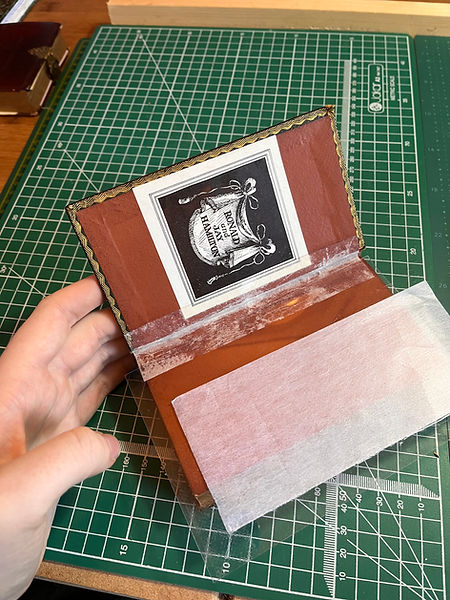
My next stage was to secure the inside front cover. This hinge would likely receive the most use once the book was repaired and was also the weak point which allowed the spine to detach in the first place. To secure this, I took a similar approach to re-attaching a loose page. I cut some Kozo paper to the correct length and a 5cm width, laminated it using the offset method and applied it onto the cover and front page using a bone folder. Looking back, I could possibly have used a thinner piece but I wanted to ensure there was as much support as possible for the hinge joint. I inserted a piece of Bondina into the join and weighted the book down to allow it to dry.
Upon examining the join the next day, I am glad to say that the Kozo had successfully stabilised the hinge and the book could now be opened and closed with ease.
My colleague had advised me that the Kozo strip would be visible and that a further step might be to use acrylic paint, mixed to the shade of the brown end papers, to disguise it. However, although I may decide to do this eventually, at the moment, I rather appreciate the visible repair. The question of whether to restore an object to as close to its original state as possible, or to simply allow it to be functional, is, I know, rather vexed and much discussed. Nonetheless, since this book will only be for my personal use, I believe I will keep the repair visible, since it speaks to the book's history as much as the hand written dedication on the fly leaf and the decorative bookplate on the inside cover.


